

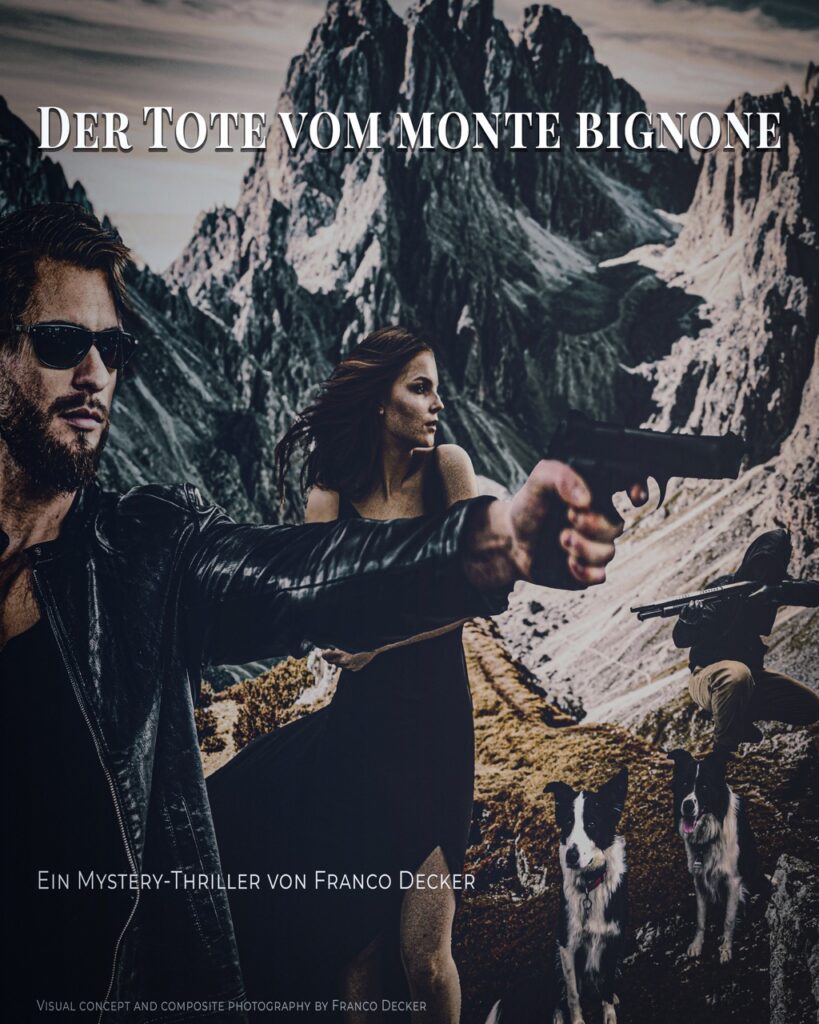
Death on Monte Bignone
Writing from landscape, memory and unease
This novel did not begin with a plot.
It began with a place — the Ligurian mountains above the coast, the paths I know, the silence that settles when familiar landscapes start to feel slightly displaced.
Death on Monte Bignone grew out of observation rather than intention, from walking, looking, and sensing that something in the landscape resisted being merely scenic.
The story emerged slowly, shaped by atmosphere more than by structure.
From Image to Narrative
Much of my writing process is rooted in visual thinking.
Before scenes existed as text, they existed as images:
paths disappearing into forest, abandoned structures, changing light, the tension between proximity and isolation. Photography and architectural observation played a decisive role — not as documentation, but as a way of understanding space, rhythm and silence.
Writing became a way to translate these visual impressions into narrative form.
“She knew too much, smiled too often —
and maybe kissed better than she spoke.”
(Death on Monte Bignone)
Place as Protagonist
In Death on Monte Bignone, landscape is not a backdrop.
The mountains, villages and paths shape the pace of the story, influence decisions and mirror inner states. Architecture, terrain and weather are not decorative elements; they define how characters move, think and react.
This approach reflects my broader interest in how space and narrative intersect — in writing as much as in visual work.
On Process
The novel developed without rigid planning.
Scenes were written, rewritten, sometimes abandoned. Characters revealed themselves gradually, often contradicting initial assumptions. What remained constant was the attempt to stay attentive — to atmosphere, to detail, to what felt truthful rather than efficient.
In that sense, writing this book followed the same principles that guide my visual work: patience, observation and restraint.
An Ongoing Practice
Death on Monte Bignone is part of an ongoing narrative practice that moves between image and text.
Further notes on writing, visual storytelling and place will appear here over time.
More information about the book can be found here:
Deutsch: https://www.amazon.de/dp/B0FTT4M81W
English: https://www.amazon.com/dp/B0FP7N41HY
5 Comments
A component that allows for easy creation of menu items, quickly creating paragraphs of “Lorem Ipsum” and pictures with custom sizes.
Creates a button in the editor to insert a paragraph of “Lorem Ipsum” greeking text.
Easy generation and deletion of blog posts, pages, and sub pages for developers. Full site structure in one click. A plugin that generates dummy posts and dummy categories. It also allows to set names for blogs or taglines.
Contrary to popular belief, Lorem Ipsum is not simply random text. It has roots in a piece of classical Latin literature from 45 BC, making it over 2000 years old.
Creates landing pages with products using all combinations based on categories, attributes and their values. Description is supplied in the ackend (“lorem ipsum…”). Supports all features like CMS-Block, injecting widgets, blocks, or variables.